Yggdrasil and the Nine Worlds


The worldview of Norse mythology is characterised above all by the World Tree, Yggdrasil, and the nine worlds situated along this cosmic axis. Find out everything here about the cosmology, its inhabitants and the creation myth of the Viking Age.
- The World Tree Yggdrasil connects all nine worlds
- It spans three levels
- There are nine worlds: Midgard, Asgard, Jötunheim, Hel, Muspellheim, Niflheim, Vanaheimr, Álfheimr and Svartálfaheimr
- The creation of the world: from the primordial giant Ymir
Norse mythology continues to feature in films, TV series, games and stories to this day, captivating us with its gods, their adventures and the myth surrounding Yggdrasil and the nine worlds.
The symbol of a world tree as a sign of holistic life is found not only in ancient Scandinavia but also in other cultures, for example in Indian mythology (the fig tree Asvattha), among the Balts (the oak Austras koks), among the Persians (the Simurgh tree) and in indigenous cultures. A tree as the axis of the world represents the connection between heaven, earth and the underworld, and symbolises the cohesion of the various elements of the universe.

The World Tree Yggdrasil
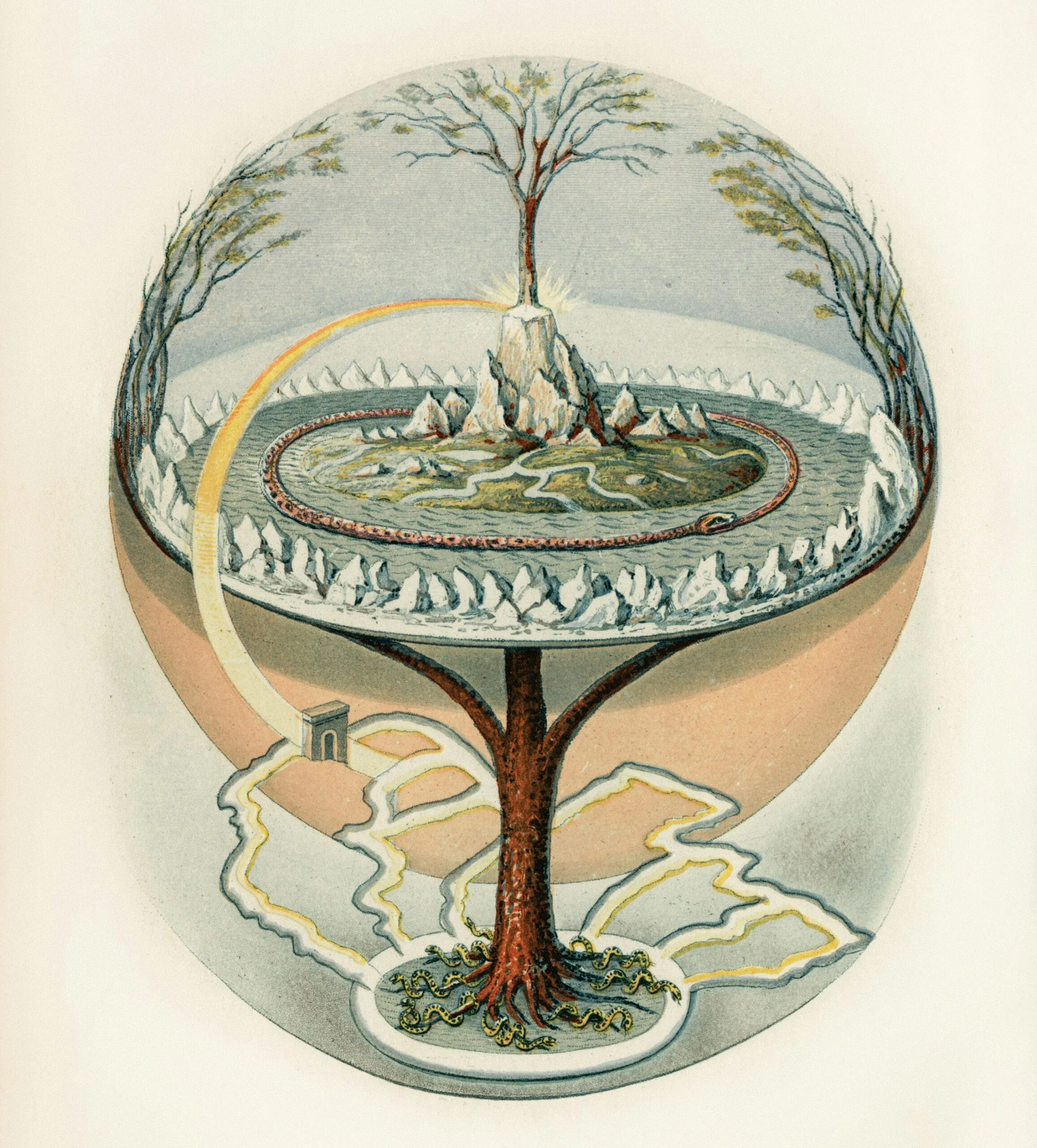
‘Yggdrasill’ translates as ‘Odin’s horse’. The name presumably alludes to Odin’s self-sacrifice and can thus take on the meaning of ‘gallows’. Yggdrasil is the World Tree of Norse mythology; a gigantic, evergreen ash tree that embodies the cosmic axis of the world.
Yggdrasil is the first tree ever to have grown; its branches tower above all nine worlds and stretch across the entire sky. This cosmos is surrounded by the primordial sea , in which the giant Midgard Serpent coils round the world.
Snorri Sturluson describes Yggdrasil in his Edda as follows:
The ash tree is the largest and finest of all trees. Its branches spread across the whole world and reach up into the sky.
In the ‘Prophecy of the Seeress’ from the Poetic Edda, the tree is described as follows:
I know of an ash tree; it is called Yggdrasil,
a tall tree, drenched in glistening moisture,
from there comes the dew that falls into the valleys,
it stands evergreen above the Well of Urd.
It is said that three roots of the ash tree extend across the whole world. Beneath one of them dwell the humans, beneath another the giants, and beneath the third lies Hel, the realm of the dead.
The Wells
Beneath Yggdrasil are also Urd’s Well, Mimir’s Well and the spring Hvergelmir. However, these three names could also refer to different names for a single spring.
Urd’s Well ( ‘Well of Fate’) is mentioned as a spring beneath one of Yggdrasil’s roots. It is here that the gods hold their councils. Nearby dwell the three Norns, who determine fate and tend the well.
Mimir’s Well is the well of wisdom from which Odin seeks counsel. There may be a connection here to Mimir’s head, which is described as a wise counsellor.
Hvergelmir is said to be a spring from which the world’s rivers are said to spring.

Animal inhabitants
The squirrel Ratatoskr ( Old Norse: ‘Driller-Tooth’) runs along the trunk of Yggdrasil and delivers messages that sow discord. Then there is the dragon Níđhöggr, who sits beneath the roots of the World Tree and gnaws at them. There is also mention of an eagle perched in the tree’s branches, as well as four stags grazing on the branches.
Three realms
There are nine worlds on Yggdrasil. These can be broadly categorised into three realms: the Upper World, the Earth on the surface, and the Underworld.
Upper World
High up in the World Tree lie Vanaheimr ( Wanenheim), Álfheimr ( Albenheim) and Asgard, the home of the Aesir. From here, the rainbow bridge Bifröst leads to the realm of mortals.
Earth
On the Earth’s surface, around the trunk of Yggdrasil, lie the human world of Midgard, Jötunheim, Muspellsheim and the region of Utgard, which refers to the northern and hostile area beyond the world inhabited by gods and humans, where demons and giants dwell.
Underworld
Beneath the World Tree lie the realms of Svartálfaheimr ( the realm of the Black Elves), Niflheim and Hel.
The Nine Worlds
The Eddas, the most important sources of Norse mythology, tell of nine worlds inhabited by various peoples and creatures.
Midgard
The name Midgard can be translated as ‘dwelling place in the middle’ and refers to the world inhabited by humans. It is situated at the centre of the cosmos. Midgard is surrounded by a protective wall designed to shield the world from the dangerous forces of chaos that dwell in Utgard, the outer world.
Asgard
Near Midgard lies Asgard, the home of the divine Aesir. The two worlds are connected by Bifröst , a rainbow bridge across which the gods ride and which is guarded by Heimdall. Asgard is home to various residences and halls, such as Valhalla and Folkwang – the halls of heroes who have fallen in battle and the dwellings of Odin and Freyja – or Vingólf, the beautiful temple of the Ásinn, where the fallen may also reside.
Jötunheim
Jötunheim, the ‘world of the giants’, is, as the name suggests, the home of the dangerous giants. This demonic world is situated far to the east ( or, later, more to the north) of Midgard. It is separated from the world of humans by rivers and the Iron Forest.
Hel
The realm of the dead, Hel, lies to the north and beneath Midgard. It receives all those who have not died in battle or at sea. (Those who die in battle go to Odin or Freyja; those who drown end up at the bottom of the sea with the goddess Rán.) Hel was, however, presumably not regarded as a place of punishment (i.e. a kind of ‘hell’), but rather as a neutral abode for those who died of illness or old age. In his Edda, Snorri also mentions Hel, the goddess of the dead, who is said to rule over this realm; however, she may also be a personification of the place itself.
Muspellheim
The ‘World of Muspell’ describes a fiery region in the south that existed even before the creation of the world. It forms the antithesis to the icy Niflheim. The sparks rising from the flames in Muspellheim form the celestial bodies above the worlds.
Niflheim
Niflheim, too, existed before the creation of the world. The name can be translated as ‘the dark world’ and describes a realm of ice, mist and darkness. It lies in the north and was perhaps associated with the polar night. One of Yggdrasil’s three roots extends into Niflheim; beneath it lies the spring Hvergelmir.
Vanaheimr
Vanaheimr, or Wanenheim, is the home of the Vanir, the second race of gods. However, as with the Vanir themselves, Vanaheimr may well be a later invention by Snorri.
Álfheimr
The‘world of the álfar’ is a celestial region and the home of the light álfar. However, the name Álfheimr is sometimes also used to describe Freyr’s dwelling place; it could therefore also refer to a divine abode situated in Asgard.
Svartálfaheimr
Svartálfaheimr, or the ‘World of the Black Elves’, refers to the subterranean home of the dwarves. It is possible that the peoples of the dwarves and the Black Elves may have been equated in this context.
History(ies)
Creation of the World
At the dawn of time, there was Ginnungagap, a void. It lay between the fiery Muspellheim to the south and the icy Niflheim to the north. When sparks from Muspellheim struck the ice of Niflheim, the primordial giant Ymir was born. He was nourished by the primordial cow , who licked Buri – the progenitor of the gods – free from the ice. Buri’s grandsons were Odin, Vili and Vé. The three gods eventually slew Ymir and created all existing things from his body.
The earth is created from his flesh, the mountains from his bones, the vault of heaven is formed from his skull and the seas from his blood. Furthermore, it is said that the trees were created from his hair, Midgard from his eyebrows and the clouds from his thoughts.
The three gods then fashioned the first human couple, Ask and Embla, from two tree trunks.
Odin’s Self-Sacrifice
It is said that Odin made a sacrifice of himself to himself. To do so, he hung from the World Tree, Yggdrasil, for nine days with a spear wound, in order to gain knowledge of the runes (and thus the ability to practise magic).
It was customary in sacrifices to Odin to hang the victim and wound them with a spear. Odin’s sacrifice to himself thus also refers to this practice.
I know I hung from the wind-swept tree
for nine whole nights,
wounded by the spear and consecrated to Odin,
myself to myself,
on the tree of which no one knows
from which root it grew.
(Hávamál 138)
Sources
- The Edda by Snorri Sturluson
- The Poems of the Gods from the Elder Edda
- Simek, Rudolf: Encyclopaedia of Germanic Mythology (2021)