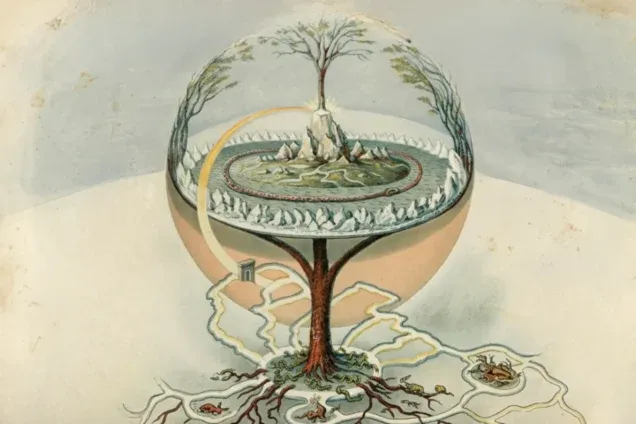
Norse Gods from A to Z


Once feared and revered, today they are marvelled at and have been brought back to life in films, books and games. The gods of Norse mythology have always held a great fascination for people, both then and now. The names Thor and Odin are probably familiar to everyone. But who else is there? Who was the goddess of the drowned, whose wicked mouth was sewn shut, and who was born of nine mothers?
- Odin, Thor and Loki are among the principal gods
- Freya, Frigg and Hel are important goddesses
- The Aesir and the Vanir form two families of gods
- Ragnarök describes the downfall of the world of the gods
There are countless films and TV series that deal with Norse mythology or have been inspired by it, such as the Netflix series Ragnarök or the Thor-films from the Marvel Universe. But what is fact and what is fiction? How were the gods actually worshipped back then?
This article aims to present the deities of Norse mythology as authentically as possible. To this end, we draw on academic studies and research into the Viking Age. We will first introduce the most important gods, then list all known Aesir and Vanir, along with their domains and the most important sources, in an alphabetical table .
The difficulty with the sources
It is not at all easy to find out exactly who the Norse gods were, what roles they played and what significance they held for the Scandinavians. This is primarily due to the limited availability of sources, as the Vikings themselves never recorded their beliefs in writing.
The most important sources are two ancient texts, the two Eddas. The Prose Edda, written down by Snorri Sturluson in Iceland, narrates stories about the gods. There is also the Poetic Edda, which contains traditional poems about the deities. Rock carvings, archaeological finds and ancient place and personal names provide further insight into the existence and significance of the Norse gods.
Today, there are many different versions of the mythological stories and gods of the North, some of which were presumably embellished with additional details only later on. Snorri Sturluson, for example, did not write down his Edda until just under 200 years after the end of the Viking Age (and thus the belief in the Norse gods), though in many parts he employed artistic embellishment or based them partly on oral traditions. And we are all familiar with the principle of ‘Chinese whispers’.
In this article, we refer to the versions that, according to academic research, are best substantiated and are likely to correspond most closely to the actual beliefs in ancient Scandinavia.
The divine lineages
In Norse mythology, a distinction is made between two families of gods: the Aesir and the Vanir. A war broke out between them – the so-called Vanir War – but they eventually made peace.
Both families of gods live in Asgard and are related to the giants. They are all ultimately threatened by the end of the world, Ragnarök , and most of them are prophesied to die in this final battle. They are therefore not immortal. Furthermore, they age; to prevent this, they eat Iðunn’s magical apples, which keep them young.
Aesir
The Aesir are the larger and more significant family of gods. They mainly comprise gods of war and dominion, such as Odin, Thor and Tyr. The first Aesir was Odin’s grandfather, Buri. According to legend, he sprang from salty ice that had been licked by a cow.
Vanes
The Vanir are thought to be fertility gods who were invoked by the agrarian population. They ensure good (or bad) harvests, sunshine, rain, favourable winds and weather conditions. In contrast to the Aesir, marriage between siblings is apparently permitted among the Vanir, as in the case of Freyja and Freyr. However, this family of gods is only mentioned in the Prose Edda, where they are distinguished from the Aesir; for this reason, some doubt their existence during the period when the faith was practised.
The most important gods
Before we list all the gods of Norse mythology in alphabetical order, we will present the most important and best-known deities in somewhat greater detail here.
Odin
Odin (Old Norse: ‘Óđinn’) was also known as Wodan , from whom the day of the week ‘Wednesday’ (Wodan’s day) derives. His name is thought to be related to rage or obsession.
He is the chief god of Norse mythology, the father of the gods, and an extremely multifaceted figure. He is known as the god of poetry, the god of the dead, the god of war, the god of magic, the runes, ecstasy and healing. It was said that Odin gathers the brave warriors who have fallen in battle around him in Valhalla , so that they may assist him in the battle against the forces of the underworld at the end of the world, Ragnarök.
Characteristics
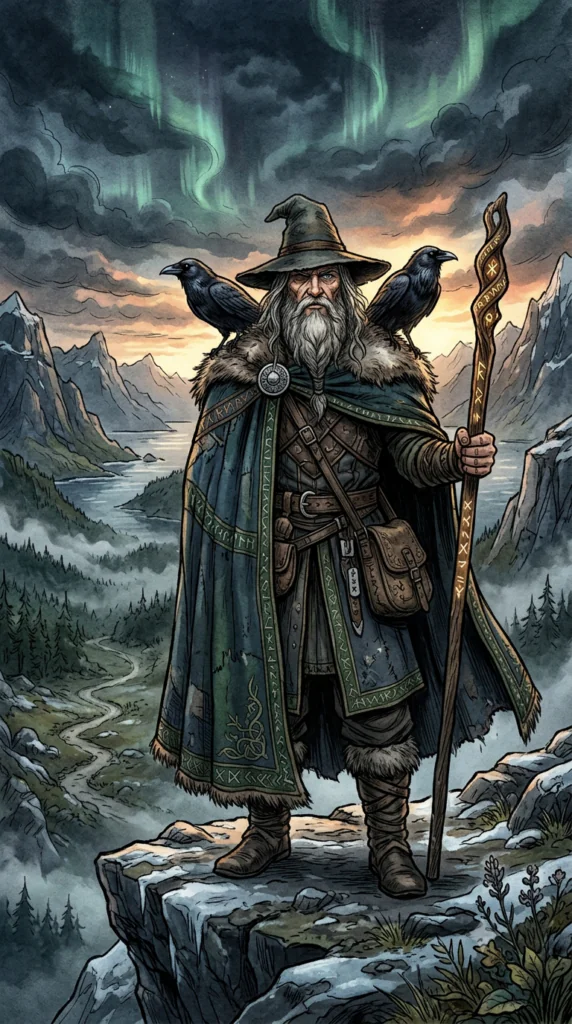
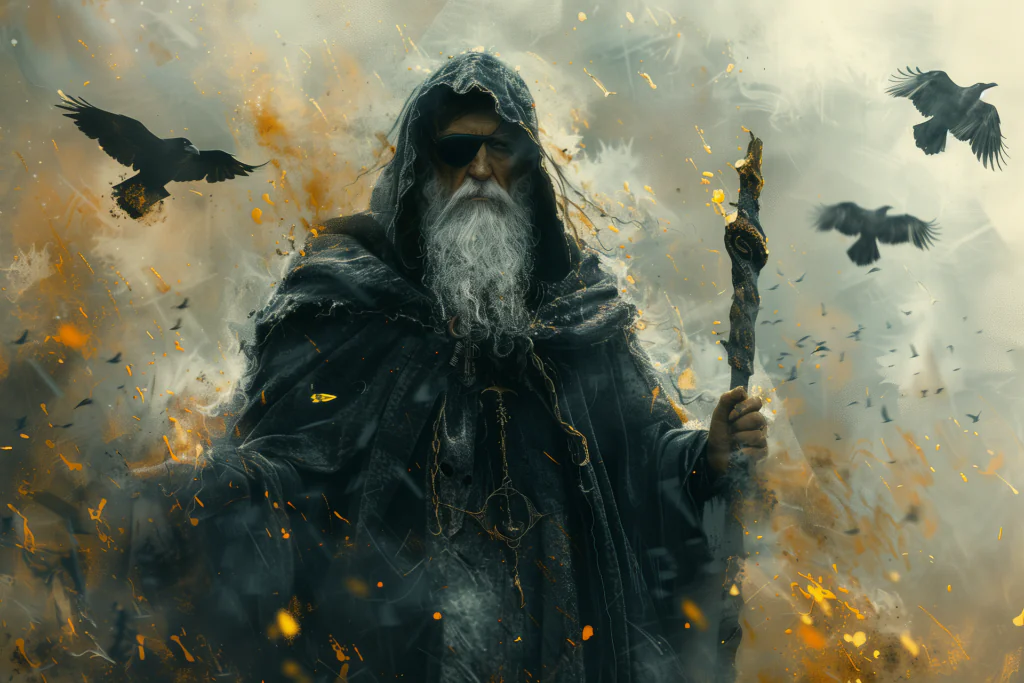
He is described as one-eyed and a shape-shifter. He wears a hat and a cloak, as well as carrying the spear Gungnir and the precious ring Draupnir. His mount is the eight-legged horse Sleipnir, and his two ravens, Huginn and Muninn, fly across the world and bring him news each morning.
Family
Odin’s father is Burr, his mother the giantess Bestla. He has two brothers: Vili and Vé. His wife is Frigg, with whom he has a son, Balder. With the giantess Jörđ, he fathered the god of thunder, Thor. He also has a third son, Váli, with the goddess Rindr.
Fun Fact!
In cult and folk belief, Odin probably played a much less prominent role than in the records. He was worshipped more by the ruling classes (whereas Thor was far more popular amongst the common people). He is presumably so popular in written sources because these originate from poetry , and Odin, as the god of poets, was greatly revered by them.
Thor
Thor (Old Norse ‘Þórr’) was also known as Donar in southern regions. The day of the week ‘Thursday’ (Thor’s day) can be traced back to his name.
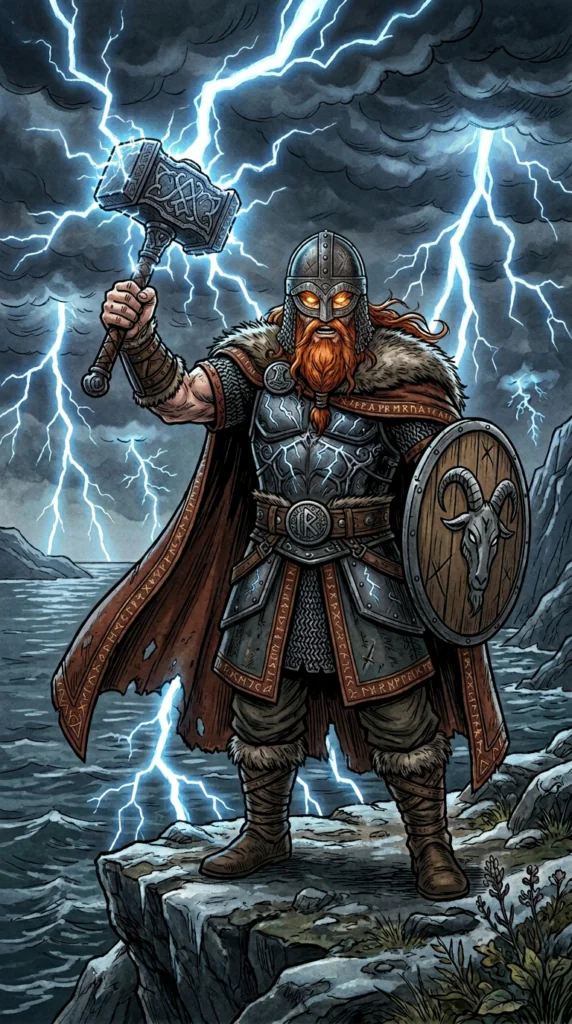
He is the god of thunder and the strongest of the Aesir; he is also regarded as the defender against threatening forces (the slayer of giants and the Midgard Serpent). Thor held great significance in Norse mythology and is mentioned very frequently in the sources. His journeys to the land of the giants, with Loki as his companion, are often described, during which he experiences many battles and adventures.
Characteristics
He is described as tall and powerful, with a red beard and a piercing gaze. He is a great eater and drinker and possesses great strength and wrath, yet at the same time he is also regarded as rather simple-minded. He has a chariot drawn by billy-goats, which is why he is sometimes referred to as the ‘Lord of the Goats’ or the ‘Chariot God’. He possesses a belt of strength, an iron gauntlet and the heavy hammer Mjöllnir, which he can also throw and which serves as a feared weapon in battle.
Family
Thor is the son of Odin and the giantess or Earth Mother Jörđ. He is therefore Balder’s half-brother. His wife is the goddess Sif, with whom he has two sons, Móđi and Magni, and a daughter, Thrúđr.
Fun Fact!
Thor’s goats have the ability to be slaughtered and eaten, but then brought back to life. For this to happen, however, all their bones must still be intact; if one is missing, the revived animal will also be missing that bone.
Loki
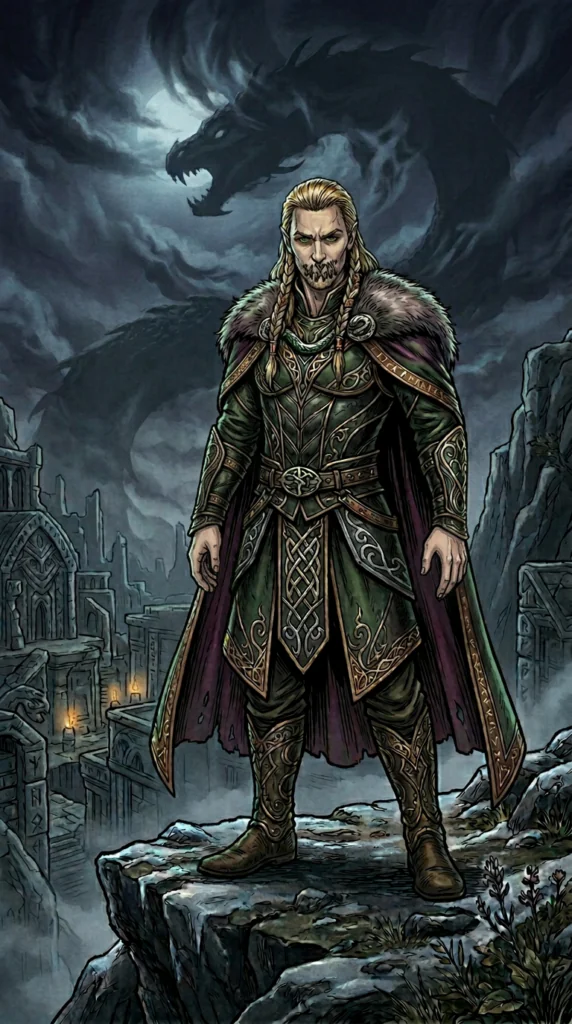
Loki is one of the Aesir, though he has no specific area of responsibility. He is a highly complex, ambivalent and unpredictable character. He is sometimes described as a ‘trickster’ and appears at times as a deceiver, at times as an ally and at times as an enemy of the gods. He often accompanies Thor on his adventures.
Characteristics
In Snorri’s account, Loki is described as handsome and of pleasing appearance. He is a shape-shifter and , for example, takes on the form of an animal in some stories; sometimes he also transforms himself into women. As he repeatedly draws attention to himself with his wicked tongue, a dwarf sews his mouth shut at one point in the Snorri Edda.
Family
Loki’s parents are the giant Farbauti and Laufey; he is also Odin’s blood brother. His wife is Sigyn, with whom he has the sons Vali and Narfi. He is also the father of the gods’ enemies: the Midgard Serpent, the Fenris Wolf and Hel, whom he sired with the giantess Angrboda. Through a ruse, he once transformed himself into a mare, in which form he gave birth to Odin’s eight-legged horse, Sleipnir .
Fun Fact!
Quite often, the stories unfold in such a way that Loki’s initially malicious intentions ultimately result in something beneficial for the gods and humans; this is how, for example, the invention of the fishing net is explained. Originally, Loki may therefore have played more of a cultural hero’s role.
Balder
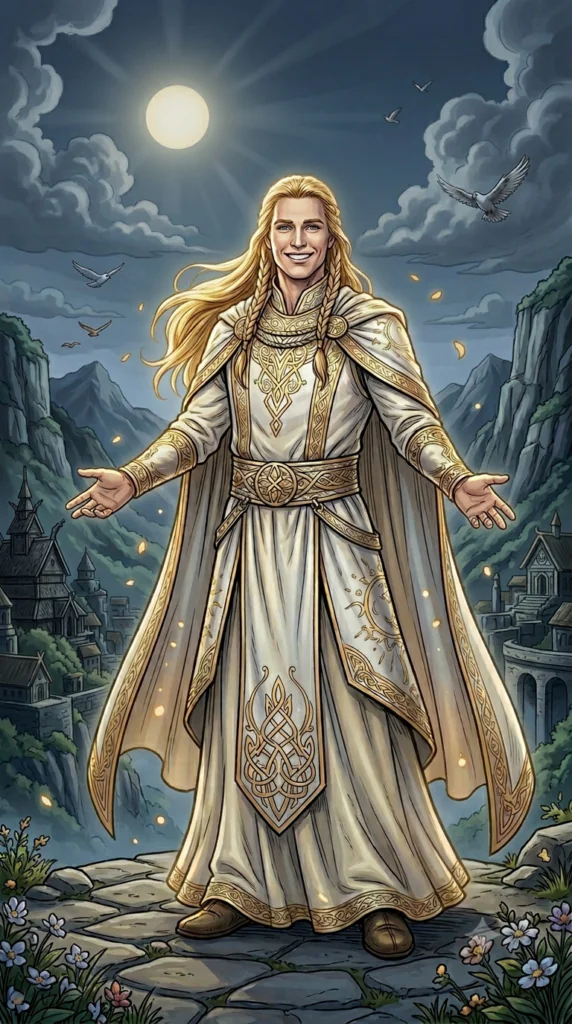
Balder (or Baldur) is one of the most important gods in Norse mythology. He is the god of light and a very positive figure. When he dies (as a result of Loki’s trickery) and is taken to the realm of the dead, Hel, this marks a pivotal moment in the mythology.
Characteristics
Balder is handsome and has a bright, radiant appearance. He is regarded as the wisest, most eloquent and kindest of the gods.
Family
He is the son of Odin and Frigg. His wife is called Nanna; with her, he has a son named Forseti.
Fun Fact!
After Ragnarök, the great battle in which almost all the gods and evil forces are slain, Balder is one of the few survivors. He returns from the realm of the dead, Hel, to live in the new world.
Frigg
Frigg (or Frigga) is the chief goddess of the Aesir. The name of the weekday ‘Friday’ (Old English ‘Frigedeag’) are thought to be derived from her name.
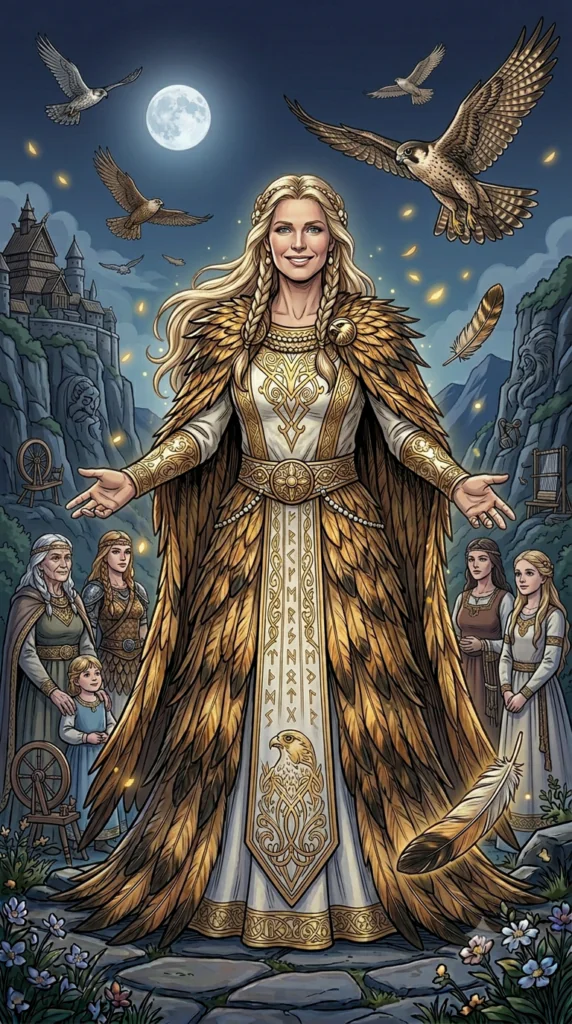
She is regarded as the goddess of women, kinship and, perhaps, love. She is particularly notable for the moment when she demands an oath from all things and beings that they will not harm her son Balder. She also possesses a falcon-gown with which she can transform herself into a bird.
Frigg is the wife of Odin and the mother of Balder. She herself is the daughter of Fjörgynn, about whom, however, nothing further is known.
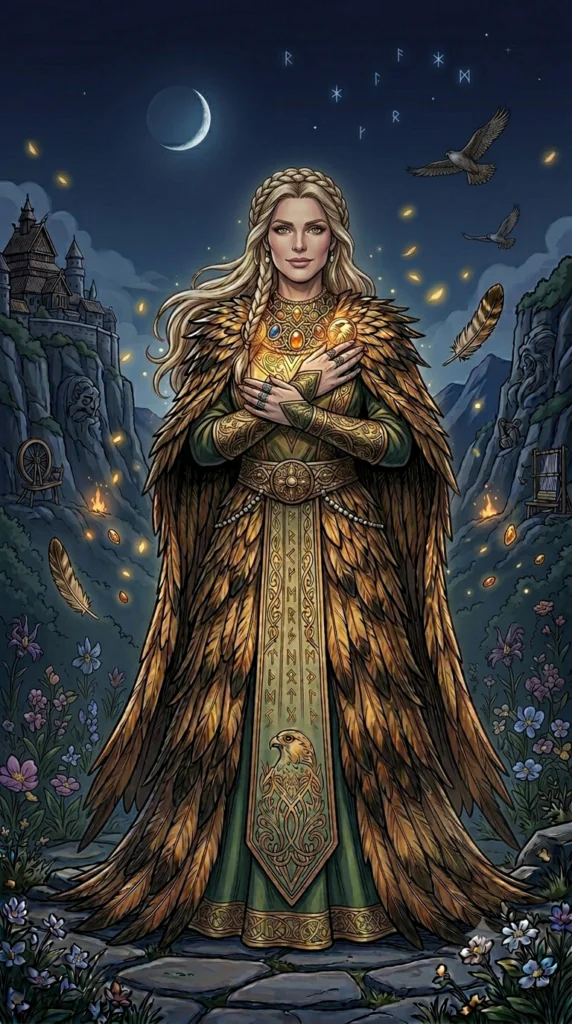
Freyja
The name Freyja (or Freya) means ‘woman’ or ‘mistress’ in Old Norse. She is the most important goddess and is counted amongst the Vanir. Freyja is regarded as the beautiful goddess of lovers; as such, she is said to favour love songs and should be invoked in matters of the heart.
Like Frigg, she possesses a falcon-feathered cloak and wears the glittering necklace Brísingamen. Some accounts tell of her travelling in a chariot drawn by cats (though this may have been mistakenly derived from images of an Oriental goddess). Furthermore, the Prose Edda states that when she goes into battle, she receives half of the warriors who fall in combat (and Odin the other half).
She is the sister and presumably also the wife of Freyr. However, in some sources the god Óðr is also named as her husband.
Freyr
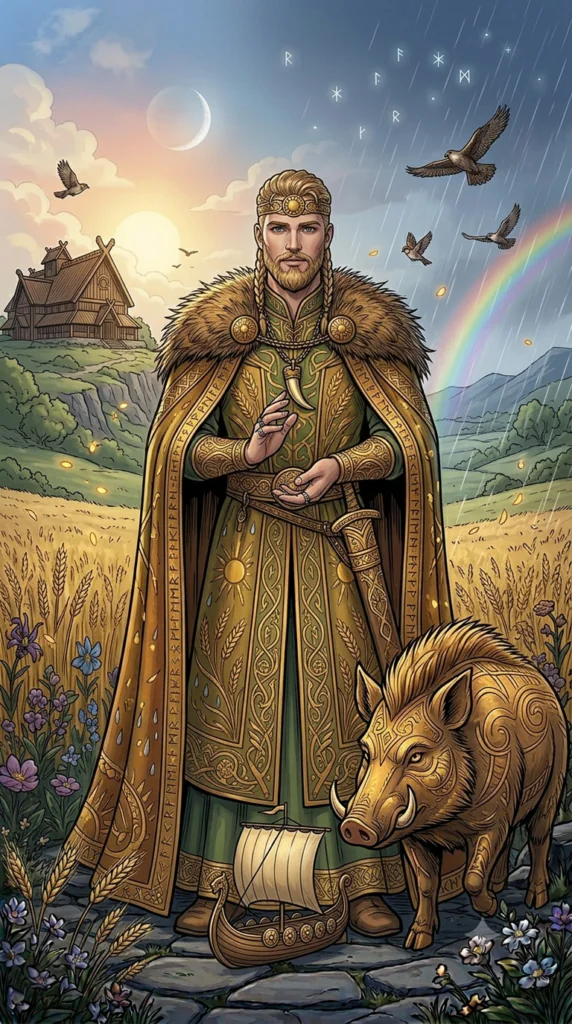
In Old Norse, ‘Freyr’ means ‘lord’. He belongs to the Vanir and , alongside Odin and Thor, is one of the most important gods in Norse mythology.
In the Prose Edda, he is described as the most noble of the gods, ruling over rain, sunshine and the growth of the earth. He was therefore invoked to ensure good harvests and to bring peace . He is also associated with a boar.
Freyr is the brother of Freyja and, according to Vani custom, presumably also her husband. However, it is also reported that, amongst the Aesir, he woos the giantess Gerðr.
Njörðr
Njörđr also belongs to the Vanir. He rules over the sea and the wind and was therefore invoked for seafaring and fishing; he also controls fire and is considered to be very wealthy.
He lives by the sea and is the father of Freyr and Freyja. He also marries Skađi, though the marriage is not a happy one, as Skađi wishes to live in the snow-covered mountains whilst Njörđr prefers the sea. They initially agree to take turns living in each other’s place for nine days at a time, but eventually Skađi retreats entirely to the mountains.
Hel
The name Hel refers to the underworld, to which all humans who have not died in battle go. In Snorri’s account, the goddess of the underworld is also called Hel. She is the daughter of Loki and is described as gloomy and grim, as well as half-black, half-pale.
However, it cannot be ruled out that she is a later, poetic personification of the underworld.
Tyr
Tyr (or Týr; in the south also Tiu or Ziu) is the one-armed god of the heavens, war and assembly. The name of the day ‘Tuesday’ is dedicated to him.
Although he was presumably a very important god, very little is recorded about him in the sources. The name Tyr may possibly have meant ‘god’, which would further attest to his central position.
The Prose Edda describes how Tyr lost his right arm because he offered it as a pledge when the gods sought to bind the wolf Fenrir . As part of their plan, they lured the wolf into a trap and bound him with magical chains. As the gods had thereby broken their promise to Fenrir not to deceive him, Fenrir bit off Tyr’s arm in retaliation. Tyr thus willingly sacrificed his arm to restore the cosmic order (which had been disrupted by Fenrir’s freedom).
Heimdall
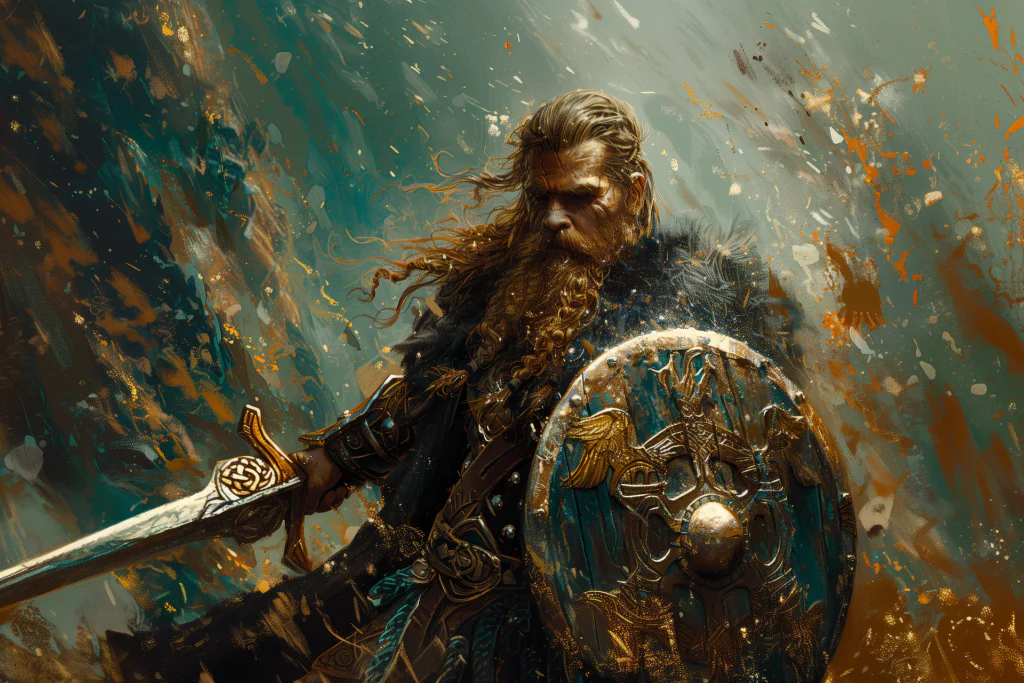
The meaning of Heimdall’s name is unclear, though it could possibly be translated as ‘he who illuminates the world’. Heimdall was regarded as the guardian of the gods and of the heavenly bridge Bifröst; he was also called ‘Father of all mankind’.
He was born of nine mothers and is associated with the sign of Aries. Heimdall is Loki’s mortal enemy, and it is prophesied that the two will kill one another at Ragnarök.
Skađi
Skađi is a ‘ski goddess’ who goes hunting with bow and arrow. She is the wife of the god Njörđr and the mother of Freyr and Freyja. Her father is the giant Thjazi.
Snorri recounts that Thor slew Skađi’s father, whereupon she sought to avenge him. The gods then offered her a compromise: she might choose a husband from among the Aesir, but would only be allowed to see their feet. Hoping it would be Balder, she chose the one with the most beautiful feet, only to discover it was Njörđr. The marriage was unhappy because she did not want to live with him by the sea, so she moved back to the mountains on her own.
Sif
Sif is Thor’s wife and the mother of the god Ullr. Her role is rather insignificant, leading to the assumption that she was merely seen as a complement to Thor. Her name simply means ‘relative by marriage’.
Snorri recounts a story in which Loki cut off Sif’s hair as a prank. Thor was very angry about this, so Loki had dwarves (among other things) craft a magical replacement head of gold hair for Sif, which grows just like real hair.
Iđunn
Iđunn’s name means ‘the Rejuvenator’. She is Bragi’s wife and is rarely mentioned, but her name reveals her special role: she guards a chest containing magical apples which the gods eat when they grow old, so that they may become young again.
List of all Norse gods
The following table lists all known gods in alphabetical order, along with their areas of responsibility and the most important sources (an explanation of the abbreviations follows below).
| Deity | Domain/Characteristic | Main source |
| Ägir | Sea giant, with characteristics of a sea god | Skaldsk, Ls |
| Balder | God of light and goodness | Gylf, Skaldsk |
| Bragi | God of poetry and eloquence | Gylf, Skaldsk, Grm, Ls, Grettir’s Saga |
| Eir | The Aesir’s greatest healer | Gylf |
| Forseti | God who settles disputes | Gylf, Skaldsk, Grm |
| Freyja | Goddess of lovers | Gylf |
| Freyr | God of fertility, weather, the harvest, peace and wealth | Gylf, Vsp |
| Frigg | Chief goddess of the Aesir, goddess of women, Odin’s wife | Gylf, Skaldsk |
| Fulla | Frigg’s handmaiden | Skaldsk |
| Gefjon | Goddess of fertility and protection | Gylf, Ynglinga saga |
| Gná | Frigg’s messenger | Gylf |
| Gullveig | Wanin, seeress/sorceress, personification of greed for gold | Vsp |
| Heimdall | Guardian of the gods and the Bifröst | Gylf, Grm, Ls, Vsp |
| Hel | Goddess of the Underworld | Gylf |
| Hermóđr | Balder’s brother | Gylf |
| Hlín | Protector goddess of mankind | Gylf |
| Höđr | Baler’s blind brother | Gylf, Skaldsk |
| Hœnir | gives people their wits | Vsp |
| Iđunn | Keeper of the rejuvenating apples | Gylf |
| Jörđ | Goddess of the Earth, Aesir/giantess, mother of Thor | Gylf, Skaldsk, Thrk, Ls |
| Kvasir | Created as part of the peace treaty between the Aesir and the Vanir, he symbolises wisdom, poetry and mead | Gylf, Skaldsk |
| Lođurr | Companion of Odin and Hœnir, bestows beauty and the warmth of life upon mankind | Vsp |
| Lofn | Goddess of marriage and consent | Gylf |
| Loki | God of cunning and trickery | Glyf, Skaldsk, Ls, Vsp |
| Magni | Son of Thor, the Mighty | Skaldsk, Vm |
| Móđi | Son of Thor, the Wrathful | Gylf, Skaldsk, Hym, Vm |
| Nerthus | Goddess of the Earth | Germ |
| Njörđr | God of the sea, the winds, fire and wealth | Gylf, Skaldsk, Grm, Skm, Thrk |
| Odin | Chief god/Father of the gods, god of warriors, the dead, magic and poetry | Gylf, Skaldsk, Hrbl, Háv, Vm |
| Óðr | Husband of Freyja | Gylf, Skaldsk, Vsp |
| Rán | Goddess of the realm of the dead at the bottom of the sea/of the drowned, wife of Ägir | Skaldsk |
| Rindr | Mother of Odin’s son Váli | Gylf |
| Sága | Protective goddess | Gylf, Grm |
| Sif | Thor’s wife with golden hair | Gylf, Skaldsk, Hym, Hrbl, Thrk |
| Sjöfn | Goddess of love | Gylf |
| Skađi | Goddess of the hunt and skiing | Gylf, Skaldsk, Hdl, Grm, Ls |
| Snotra | wise goddess of good behaviour | Gylf |
| Sol | Personification of the sun | Gylf, Grm, Vm |
| Syn | Protective goddess, guardian of the doors | Gylf |
| Thor | God of thunder | Gylf, Skaldsk, Grm, Thrk, Hym, Ls, Vsp |
| Tyr | God of the sky, war and assembly | Gylf, Skaldsk, Ls, Hym |
| Ullr | God of skiing, archer, warrior, son of Sif | Glyf, Skaldsk |
| Vali | Avenger of Balder | Bdr, Hdl, Vm |
| Vár | Goddess of Oaths | Gylf, Thrk |
| Vé | Brother of Odin | Gylf, Ls |
| Vidar | a strong and taciturn god | Gylf, Vsp, Vm, Grm |
| Vili | Brother of Odin | Gylf, Ls |
| Wör | wise goddess who asks many questions | Gylf |
Source abbreviations
Snorri’s Edda
| Gylf | Gylfaginning/Gylfi’s Deception |
| Skaldsk | Skáldskaparmál/The Language of Poetry |
Poetic Edda
| Bdr | Baldr’s Dreams |
| Grm | Grímnismál/The Song of Grímnir |
| Háv | Hávamál/The High One’s Sayings |
| Hdl | Hyndluljóð/The Song of Hyndla |
| Hrbl | Hárbarðsljóð/The Song of Hárbarð |
| Ls | Lokasenna/Loki’s taunting speech |
| Skm | Skírnismál/The Song of Skírnir |
| Thrk | Thrymskviða/The Song of Thrym |
| Vm | VafÞrúðnismál/The Song of Vafþrúðnir |
| Vsp | Völuspá/The Prophecy of the Seeress |
Tacitus
| Germ | Germania |
Dive deeper
If you want to dive deeper into the fascinating world of Norse gods and myths, there are plenty of ways to do so. As well as books that retell the mythology in an engaging way, or non-fiction works packed with background facts, there are also comics, films (such as Thor (2011) or The Northman (2022)), TV series (e.g. Vikings, The Last Kingdom or Ragnarök) and games (such as God of War Ragnarök and Assassin’s Creed Valhalla) that explore and reinterpret these themes.
To follow in the footsteps of the ancient Scandinavians first-hand, you can also visit Viking-themed attractions in Norway, Sweden, Denmark and Iceland.
FAQ
What is the difference between the Aesir and the Vanir?
The Aesir are the larger and more significant family of gods; they are primarily gods of war and rule. The Vanir are thought to be fertility deities.
Are the Norse gods immortal?
The gods must regularly eat Iðunn’s apples to remain young. Furthermore, it is prophesied that most of them will meet their end during Ragnarök. They are therefore capable of ageing and dying.
What happens during Ragnarök?
Ragnarök is the prophesied end of the world, during which the gods go into battle against the forces of chaos (such as giants, the Midgard Serpent and Fenrir the wolf). Almost no one will survive this battle.
Which Norse goddess is associated with love?
Freyja is regarded as the beautiful goddess of lovers. However, Sjöfn is also referred to as the goddess of love, whilst Vár watches over marriage and vows of fidelity.
How were the Norse gods worshipped?
In religious practice, there were stone altars in the open air (‘Hörgr’), sacrifices (‘Blót’, usually animals but sometimes also humans), festivals and runestones bearing invocations. Small Thor’s hammers were worn as amulets, and the names of the gods were frequently incorporated into personal and place names.
Sources
- The Edda by Snorri Sturluson
- The Poems of the Gods from the Elder Edda
- Simek, Rudolf: Encyclopaedia of Germanic Mythology (2021)
- Krause, Arnulf: The Gods and Myths of the Germanic Peoples (2020)